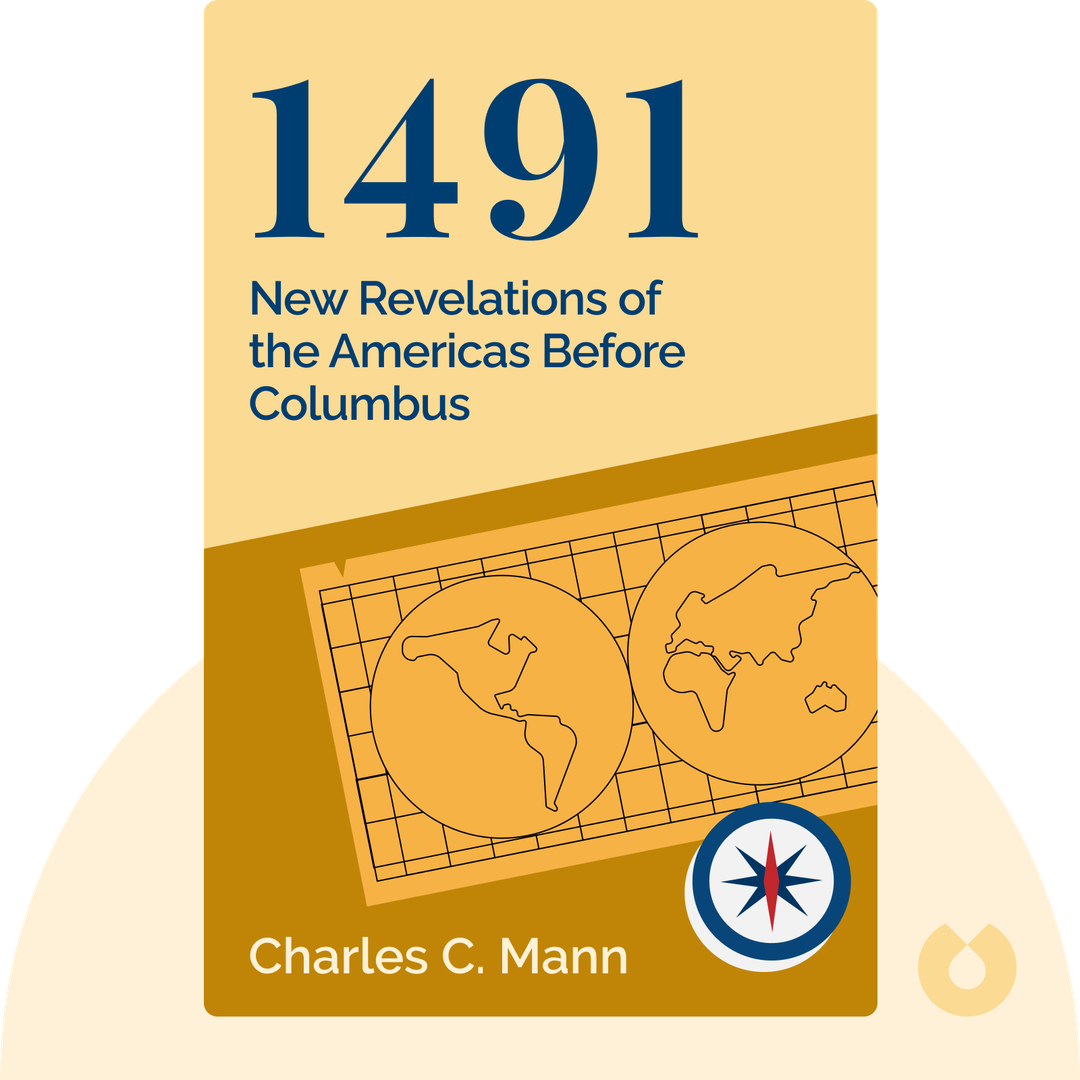
Theme Song
If You're Curious About These Questions...
You should listen to this audiobook
- Did you know that before 1492, the Americas were home to thriving cities that were more populous and technologically advanced than London or Paris?
- Have you ever wondered if the "untouched wilderness" of the Amazon was actually a massive, carefully engineered garden created by human hands?
- What if the history you learned in school about a sparsely populated "New World" was actually a myth born from the aftermath of a hidden biological catastrophe?
Listen to 1491 — Free Audiobook
Loading player...
Key Takeaways from 1491
- Discover how European diseases wiped out up to 90 percent of Native populations, leading early settlers to mistake the survivors of shattered civilizations for primitive people.
- Understand why early anthropologists completely misjudged Native cultures by observing disease-ravaged refugees and mistaking them for untouched, Stone Age societies.
- Learn how pre-Columbian civilizations in the Bolivian savannah engineered massive earthen mounds and complex agricultural grids on a scale rivaling ancient Rome.
- Realize that Native Americans did not passively survive in pristine wilderness, but actively shaped and managed their environments through sophisticated farming and land management.
- Uncover the hidden truth about the pre-Columbian Americas and explore how advanced indigenous groups purposefully altered their landscapes long before European contact.
Learning Tools
Reinforce what you learned from 1491
Mind Map
1491
The Pristine Myth & Disease+
Holmberg's Mistake+
South American Engineering+
North American Management+
Mesoamerican Agriculture+
Quiz — Test Your Understanding
Question 1 of 9
Why did early European settlers mistakenly believe the Americas were a pristine, untouched wilderness?
Question 2 of 9
What fundamental mistake did anthropologist Allan Holmberg make when studying the Sirionó people of Bolivia?
Question 3 of 9
What does the massive accumulation of broken pottery in the earthen mounds (lomas) of the Beni region suggest about its pre-Columbian inhabitants?
Question 4 of 9
How did North American Indians successfully 'farm' wild game like elk, deer, and bison?
Question 5 of 9
According to scientists, what caused the sharp decline in global atmospheric carbon dioxide levels after the year 1500?
Question 6 of 9
Why is traditional slash-and-burn agriculture ultimately destructive in the Amazon rainforest?
Question 7 of 9
How did ancient Amazonian societies like the Marajóara successfully sustain large populations without destroying the rainforest?
Question 8 of 9
What is 'terra preta' (Indian black earth)?
Question 9 of 9
What agricultural achievement by Mesoamerican Indians is described as humanity's 'greatest feat of genetic engineering'?
1491 — Full Chapter Overview
- 1Recommendation
- 2Scholars of Native cultures have often missed the bigger picture.
- 3The Beni was home to an advanced pre-Columbian civilization.
- 4Native Americans didn’t just live off the land – they transformed it.
- 5North American Indians used fire to reshape the landscape.
- 6So many Indians died after 1500 that the global climate changed.
- 7Modern farming practices are destroying the Amazon rainforest.
- 8Many crops struggle in the Amazon, but fruit orchards flourish.
- 9Amazonian Indians developed sustainable farming thousands of years ago.
- 10Central American farmers changed how the world eats.
- 11Final summary
1491 Summary & Overview
1491 (2005) is a study of the Western Hemisphere before 1492, the year in which an Italian sailor employed by the Spanish empire first set foot in the Americas. Within a century of Columbus’s “discovery” of the New World, some of humanity’s most sophisticated cultures had all but disappeared. In 1491, Charles Mann sets out to recover their ways of life and remarkable achievements.
Who Should Listen to 1491?
- History buffs
- Myth-busters
- Americaphiles
Books Similar to 1491
Readers who enjoyed this also liked these titles.